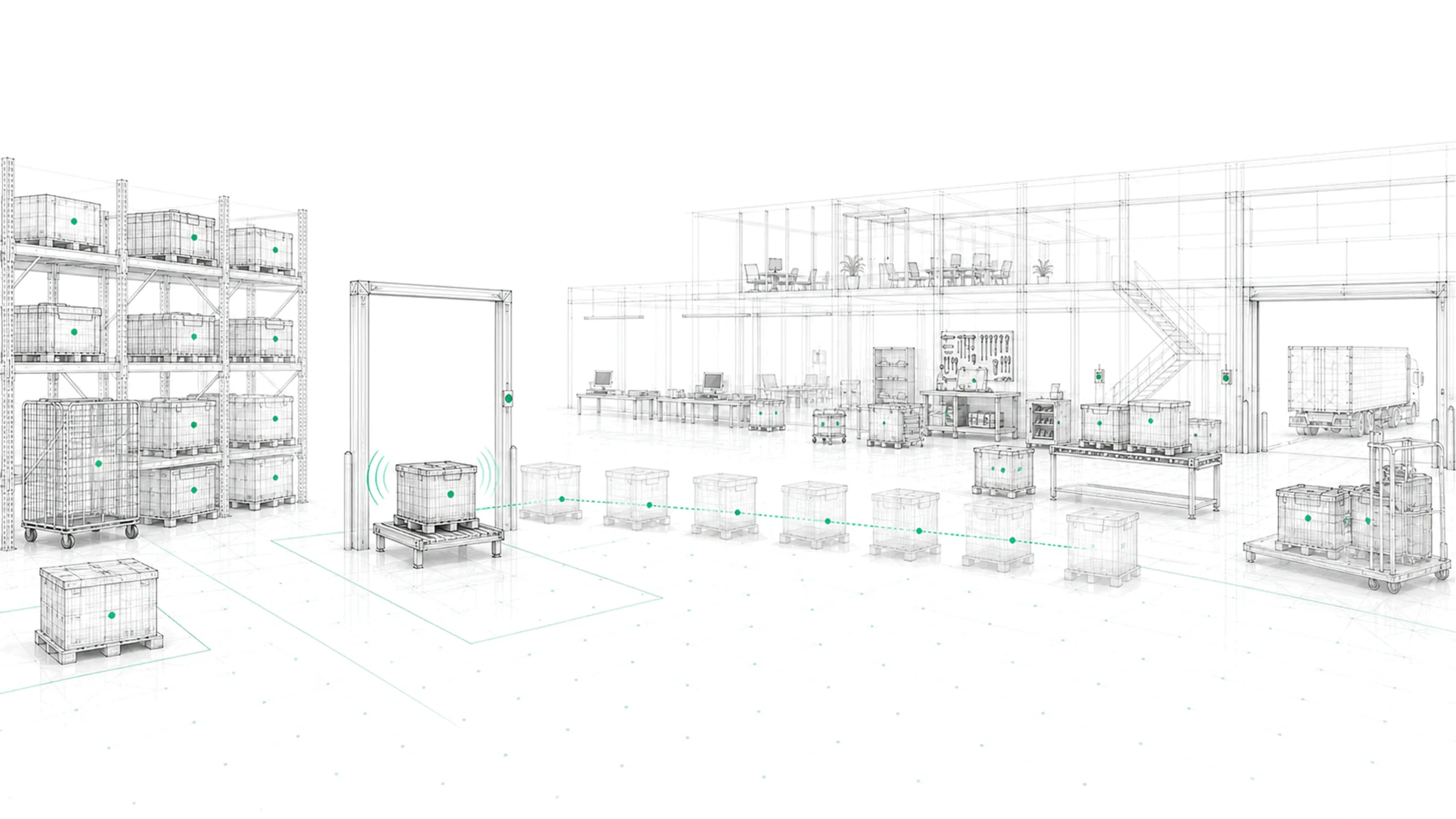
Do you know exactly how many assets you have, where they are, and in what condition, right now?
Why Trackvy
Complexity erodes Precision, Velocity, and Visibility: Trackvy is the architecture that sustains them.
As complexity increases, precision degrades and data stops reflecting reality. This is an architecture problem.
Precision · Velocity · Visibility
Both curves start at the same point. The manual model erodes gradually. As operational complexity grows, holding the same level of accuracy would demand multiplying the team's effort, coordination hours, and rework. That effort rarely scales at the pace of the business, and the shaded region is the result: inventory discrepancy, unlocated items, and decisions made on last-cycle data.
| P | Precision | Known state, location and history for every item. The data reflects its current reality. |
| V₁ | Velocity | Audits in minutes. Every decision downstream is only as good as your last reconciliation cycle. |
| V₂ | Visibility | Data is current. Deviations are detected when they occur. |
Why Trackvy
The same path
in every operation.
Three dimensions of operational control. Trackvy sustains all three as your operation grows in complexity.
-
The manual model
At first, it seems sufficient
Spreadsheets. Physical counts. Periodic audits. With few assets, it works. Scale has not yet demanded more.
-
The erosion
Complexity grows faster than the effort
More SKUs, more sites, more movements per day. Effort scales by adding steps. Complexity scales by multiplying interactions. Precision slips first. Then velocity. Then visibility.
-
Trackvy
P/V/V holds when the architecture allows it
Trackvy scales with the data. It captures every event, applies rules and improves with every cycle. More data, greater precision. The effect accumulates.
-
The gap
This is what you recover
~99% precision. Audits in minutes. Real-time traceability. Closing this gap is what Trackvy does.
Proof in the Field
More than 15 years of real operations.
These are the numbers.
~99%
Sustained precision
Typical prior baseline: ~63%
20x
Faster audits
2M+
Assets in continuous operation
10M+
Movements Recorded
15+
Years Operating in LATAM
The outcome is the product
Trackvy restores P/V/V.
Capture technology follows the diagnosis.
Accendo delivers sustained P/V/V with Trackvy. That is a distinct value proposition with distinct responsibilities.
Self-assessment
Three questions that frame the diagnostic.
Each question maps to one dimension of the model: precision, speed and visibility. The answers set the baseline that Phase 01 Diagnostic measures.
How long did your last complete audit cycle take, from physical count to updated data in the system?
How much time passed between the last discrepancy in your operation and the moment you knew about it?
Perspective
The two long reads behind the model
Accendo publishes the full development of the model and the economic analysis that goes with it.
First Step
From depending on effort to depending on the system.
Trackvy is that system. Accendo is the firm that designs and operates it with your team.