RFID UHF
Passive RFID tags are read at distances of up to 12 m without line of sight. A fixed reader can register hundreds of tags per second. The most common technology for fixed asset control, tools, and high-turnover inventories.
Capture technologies
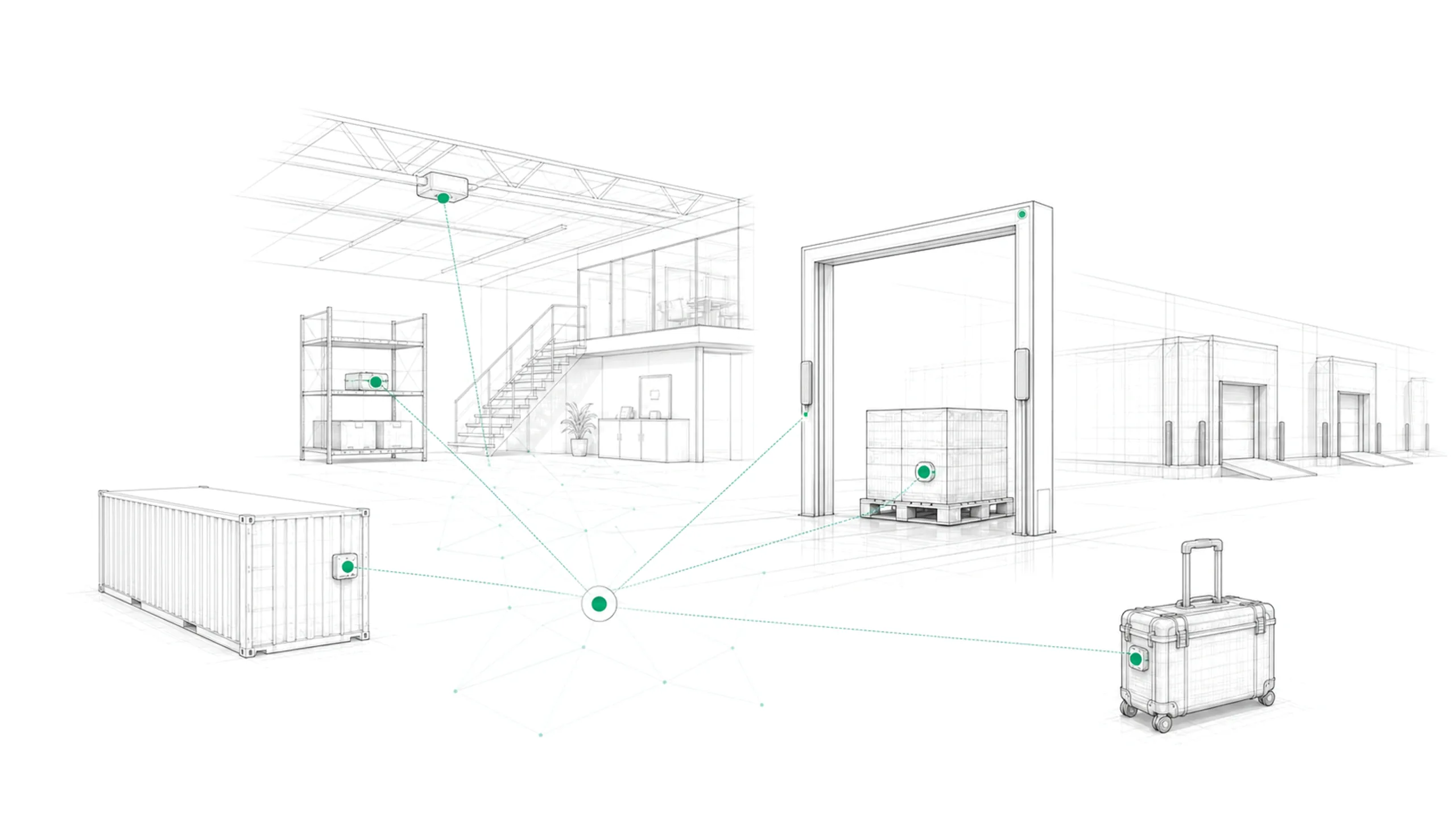
Trackvy integrates RFID UHF, Bluetooth BLE, LoRa, and 4G networks to register every item, tool, and process in real time. The technology is chosen based on the operational context; the result always lands in the same place.
RFID & IoT
There is no single universal sensor. Every operational environment demands the technology best suited to its conditions: read speed, range, physical conditions, coverage, and energy autonomy.
Trackvy absorbs that diversity. Reads from RFID, BLE, LoRa and 4G converge on one platform: one timeline per item and one dashboard for the team.
App Features
Trackvy selects and integrates the right capture technology for each scenario. Multiple technologies can coexist within the same operation.
Passive RFID tags are read at distances of up to 12 m without line of sight. A fixed reader can register hundreds of tags per second. The most common technology for fixed asset control, tools, and high-turnover inventories.
BLE beacons broadcast their identity every few seconds. Fixed readers triangulate position within a building to 2 to 5 m accuracy. Low power consumption. Long-lasting batteries without RFID infrastructure.
LoRa transmits over kilometers with batteries lasting years. Used for containers, vehicles, and machinery distributed across areas where Wi-Fi and cabling are not viable.
Sensors with cellular connectivity report GPS position, temperature, vibration, and other variables directly to the cloud. No dependency on local infrastructure. The choice for items that move outside the operational perimeter.
Selection criterion
Each capture technology solves a different problem. Before comparing brands it pays to compare operating realities: what moves, how often, and from what distance it needs to be read.
| Technology | Typical range | Tag and cost | Infrastructure | Where it adds the most |
|---|---|---|---|---|
| Manual counting | Line of sight, one item at a time | No tag | None | Low volumes with few changes. Accuracy decays with volume: 63% is the baseline we have observed in asset audits. |
| RAIN RFID (passive UHF) | 1 to 12 m, hundreds of reads per second | Low-cost passive tag, no battery | Fixed or mobile readers | Inventory and assets at volume. It is the base of the sustained ~99% accuracy we measure in operation. |
| BLE (beacons) | 50+ m detection, 2 to 5 m zone accuracy | Active tag with a multi-year battery | BLE gateways | Indoor zone presence and tracking of high-value assets. |
| LoRaWAN | 3 to 4 km urban, up to 15 km line of sight | Active tag reporting a few times per day | LoRa gateways | Yards and large sites where assets move little and distances are long. |
| Cellular tracker (4G) | Cellular network coverage, with GPS | Rechargeable device at a higher unit cost | None on site | Vehicles, containers, and assets that travel between sites. |
No single technology covers every case. Operations that sustain control combine two or three, by zone and by asset type. The Diagnostic measures your case and proposes the mix; Trackvy runs them all on the same data.
How do we help?
RFID UHF, BLE, LoRa, or 4G by environment. Data always converges in one place.
The sensor (RFID, BLE, LoRa, or 4G) detects the item and generates an event with identity, timestamp, and capture point.
The data travels to the Trackvy server via local network, Wi-Fi, or cellular, depending on the capture technology used.
Trackvy normalizes, validates, and stores the event. It compares against the expected state and generates alerts on deviation.
The dashboard shows current status, history and exceptions. Reports generate on their own and ERP export happens in real time.
Solutions
The same platform. Four operational outcomes, measurable from the first month.
Automatic inventory, accurate depreciation, missing items detected in seconds.
Continuous reconciliation between the system and the physical reality of the warehouse.
Loans, returns, and location of every tool traced without paper or radio.
Every stage of the operational process recorded automatically, from start to close.
rfid.com.co
rfid.com.co is our specialized RFID technology portal: how it works, what types of tags and readers exist, and how it is applied across industrial sectors. A technical resource developed by the same Accendo team that operates Trackvy.
Visit rfid.com.coIt depends on the physical environment, the item type and the available coverage. UHF RFID is the most common choice for warehouses and inventories. BLE suits dense indoor environments. LoRa suits outdoors without cellular coverage. 4G/NB-IoT suits critical items in motion. The diagnostic determines the right combination for your operation.
Yes. Many operations use RFID in the warehouse, BLE in the plant, and 4G for items that go out in the field. Trackvy unifies all events into a single timeline per item, regardless of which technology generated the data.
Timeline depends on capture technology, ERP integration, and item volume. The diagnosis determines the exact scope and schedule before work begins.
Yes. Trackvy exposes an open API and standard connectors for the main ERP and WMS systems on the market. Integration is part of the bounded deployment scope.
It varies by technology. Mobile RFID readers require no fixed installation. Fixed portals need power and network. BLE and LoRa sensors run on batteries and require no cabling. The diagnosis determines exactly what your operation needs.
First Step
In one session we review your operation, the capture technology that fits it and what the first expected results are, all before work begins.
Keep exploring
